In a skype chat, we figured there were 78 classes at Hope’s Peak by canon time, and if they had approximately 16 students in each class, minus the 78 SHSL Good Lucks there would be 1,170 titles. Now, it’s stated on the DR3 wiki that the SHSL Student Body President is the only one to ever share a talent. How many other talents could there possibly be?
And so, we made a list of potential ideas. Canon talents are listed at the top, and our own ideas are underneath (we forgot DR0, so those talents are somewhere among the main list).
If you’re a DR OC roleplayer, or want to make a fanstory, or just want to look at a list of cool talents for whatever reason, please feel free to use this for reference! A fun game to play is to randomize a number and make an OC with whatever talent you get. Have fun!
1: What’s your OC’s biggest insecurity and how would they react if someone pointed it out to them?
2: If your OC wants to buy a firearm, what it might be for?
3: Does your OC behave differently around different people, if so with whom and how?
4: Would your OC want to involve themselves in humanitarian work ? If yes, then for what? If not, then why not?
5: How would your OC generally react to someone being verbally abusive towards them for no apparent reason?
6: Does your OC have a realistic image of their own intelligence?
7: Does your OC have any irrational phobias?
8: How is/was your OC’s relationship with their parents?
9: Does your OC feel a pressure to achieve or are they content and calm with doing what they can at the moment?
10: Does your OC guard their emotions by being tough? If not how would they?
11: How would your OC react to hearing they’re adopted?
12: What is one of the most primary things your OC feels that is missing from their life?
13: What kind of situations does your OC avoid the most?
14: If your OC gets into a fight with their best friend, would they wait for their friend to make up with them, or would they try to make up with their friend?
15: Does your OC consider themselves a good person?
16: Is your OC good at giving others validation of their feelings and making them feel understood?
17: Does your OC suffer from any mental health issues?
18: What kind of intrapersonal values does your OC have? (values about their self, what makes them feel like a valid person)
19: What boosts your OC’s confidence the most?
20: Does your OC hurt others often unintentionally? If yes, how?
21: Does your OC hurt others often intentionally? If yes, how?
22: How does your OC usually show affection? Are they openly romantic or more restricted with their affectionate emotions?
23: Does your OC tend to hide something about their personality/essence when meeting new people? If yes, what?
24: How would your OC react if they got humiliated by someone in a group of people?
25: How would your OC process the grief caused by the death of a loved one?
26: What is the most intense thing your OC has been battling with?
27: Does your OC practise any kind of escapism? If yes, what kind?
28: How would your OC react if a bully stole their lunch money in high school?
29: How does your OC behave on the face of a conflict?
I think we’ve all been in the situation where we want to write about a specific character but have no idea how to approach it. For some reason, despite them being your own character, you have no idea how they would act or what they would say in a certain situation. Sometimes, if you even write about your character(s) at all, when you read it back they seem fake or 2-Dimensional. Unrealistic, if you’d prefer.
In this post, I am going to give you some exercises to get past hollow characters and help develop your writing.
1) Empty Their Pockets
Pretty simple. Think of what your characters would have in their pockets on a day-to-day basis. It doesn’t have to be anything super extraordinary, of course. Just start writing some everyday items down and think about whether your character would have these items in their pockets.
Let’s take a look at one I did for my characters earlier. (sorry that just sounded like something from Blue Peter)
For example:
Character A’s Pockets Contained:
pack of gum, empty pack of cigarettes, library card, NOKIA brick phone
So, here a few things you can tell about Character A simply through the items in their pockets. They visit the library often, meaning that they probably have a high interest in reading (this also could be a sign of intelligence). Judging by the fact Character A has both a pack of gum and cigarettes this could indicate a potential smoking habit, chewing gum is a known way for helping people quit smoking. The pack of cigarettes could show that they are not very good at restricting themselves and could in fact be addicted and finding it hard to cope with smoking. Finally, the NOKIA brick phone shows how they may want to feel connected to people or want to allow their friends/family members/whoever to be able to contact them but have no desire to get the latest model of phone or perhaps believe that having such a device would distract them unnecessarily.
When doing this exercise, think about key objects which portray certain details about your character! Try not to overthink it too much, write whatever comes to mind and put it down on the page! After writing down a couple objects, go back through them and feel free to edit out items you think are unnecessary or add items which you think would suit the character.
2) Go Through Their Daily Routine
Again, another easily explained exercise. Go through a regular day in your character’s life, try and do this exercise as if it was happening before whatever events occur in your story or novel. This way it makes it easier to understand your character before they met a secondary character in the novel or before whatever events happened in your writing which may affect their routine. You don’t need to include every single detail in your description, just brief notes or key events which occur during their day would be fine. You can make it as short or as long as you wish, maybe don’t just do it for one day in your character’s week perhaps do it for multiple days.
Does their routine change during the week? What time do they wake up? What time do they go to sleep? Are they punctual with going to work? Do they do any other activities outside their day-job? These are the kind of things you may want to ask yourself when writing it.
3) Give Them Fears/Phobias
Everyone fears something: whether it be a phobia of spiders or oblivion, everyone has a fear. Giving your character a phobia makes them seem more realistic, it allows your reader to easily relate to your character.
However, just having a phobia for the sake of it doesn’t help develop your character at all. If you give them a terrible phobia of snakes and they come across a snake and suddenly within moments are able to get over their fear just like that, it’s not a phobia. It’s more of a mild inconvenience than anything else. The reader needs to feel convinced by their fears, they would feel more dissatisfied with your writing if they felt the character could dismiss anything and everything than knowing them being confronted by their fears could be a possible problem. Besides, it would give them no reason to motivate or encourage the character if they knew it was impossible for them to be defeated by anything. Still, this does not mean that your character has to be destroyed by their fear. There is a very big difference between simply dismissing your character’s fear and perhaps overcoming it in the future.
An easy way to write your character possibly overcoming their fear in the future is that when they first encounter that fear, add an element of chance or fate into it. For example, if a character were to move to get away from the creature which may be coming towards them; in the process of getting up, they could slip which could cause their legs to lash out towards the creature. The sudden movement may just be enough to scare the creature away, this way it does not appear to the reader as ridiculous or uncharacteristic courage but instead accidental bravery. This sudden revelation that the character’s horrible fear may not be as all powerful as they first thought could be the first step for them to slowly overcome that fear.
Don’t believe me? Let’s think about this for a moment. Imagine your character, let’s call them the Protagonist™, is stuck in a terrible situation. It doesn’t matter what the situation is but let’s say it’s something which involves them being trapped in a room with a snake. I’m going to give you two examples, both involving the same situation.
Example #1:
Protagonist watched with wide eyes as the snake slowly slithered towards them. The snake paused for a moment, it hissed lowly as it waited for Protagonist to move, waiting for the right moment to strike. Not hesitating for a single moment, they suddenly realised how dire the situation was and jumped to their feet. Their heart pumping wildly as their body was filled with adrenaline, they were terrified yet they had to do something. Protagonist grabbed the nearest thing to them and stepped towards the snake.
“Get away!” They threatened, “Get away!”
Example #2:
Protagonist watched with wide eyes as the snake slowly slithered towards them. The snake paused for a moment, it hissed lowly as it waited for Protagonist to move, waiting for the right moment to strike. The blood in Protagonist’s veins ran cold as the snake grew closer and closer, Protagonist couldn’t move. They begged and screamed on the inside to move away, to get away as far as possible. They had lost all control of their movement, their fear had consumed them. They were frozen to the spot and could only watch as the snake widened it’s jaw, ready to bite down on it’s prey. It widened it’s jaw once, twice – suddenly, Protagonist gained back their instincts. Fleeing seemed like the only realistic option and seconds before the snake could chomp down on their ankle, Protagonist stumbled to their feet. They stumbled backwards into a puddle of water which had pooled behind them and their ankle rolled as they slipped, their legs accidentally lashing out towards the predator. The snake recoiled backwards in shock before deciding that the risk wasn’t worth it: it quickly retreated back to it’s nest, disappearing from Protagonist’s view.
Now, hopefully you see what I mean. I think we can all agree that the second example is a lot better than the first one.
4) Create Their Flaws/Bad Habits
No one is perfect, this includes your characters.
If you’re finding it challenging to think of any flaws, try to think of some bad habits. It doesn’t have to be anything so terribly bad that’s it’s illegal. Think simple when it comes to this exercise. It can range from anything between chewing their nails to swearing.
It might help to try and develop these bad habits into possible flaws or weaknesses. If your character keeps biting their nails that might be a sign of nervousness or anxiety. So, creating bad habits might be a good way to show a certain trait your character may possess.
Flaws are important as well. Let’s be realistic, if no character had any flaws then every single book we read would be filled with a bunch of characters which are exactly the same. Besides, what’s a hero without it’s villain?
So, to give you a few ideas, let’s go back to superheroes. Maybe a hero is so set on doing the right thing that they lose sight of what they want? Perhaps it gets to a certain point where they can’t handle that hollow feeling inside of them that they grow arrogant, selfish or even stubborn? There’s a story for you right there.
Not only that, by giving your characters flaws it is possible that you could work that into your story somehow. This way, not only will you get to show off your amazing character development, but it could also be an exciting point in your storyline.
Write down some ideas, think of flawed personality traits and just write them down! Try to write down at least five straight off the bat, for each one you don’t like you should think about why it doesn’t suit your character. You’re bound to find one flaw you’re happy with!
5) Write Some Scenarios
Now that you’ve developed your characters, go ahead and write them in your story! If you think you still need a bit of practice, try writing something about them being in a certain scenario. It could be anything from ordering their favourite coffee to being trapped in a prison: just write it! Try not to think about it too much, just do whatever feels write (I unintentionally made that pun but i’m not deleting it).
It doesn’t have to be long either, just a couple paragraphs would be fine. Try to focus on body movements and interior thoughts, it would be ideal if your character was on their own in the situation: that way you can get to know the character on their own a lot better. No other characters means no distractions. It’s just you, the wonderful author, and your character – there is an endless amount of possibilities for you!
Have faith in yourself too! Nobody knows your brilliantly developed characters better than you do, so here’s your chance to show them off! If you’d like a second opinion, write something about them and give it to a friend/parent/random stranger etc. to read! If they don’t want to, make them read it anyway!
I hope this helps you all in developing your characters!
8. do they like books? if so, how often do they read?
9. what are their talents?
10. two or more other fictional characters they’re similar to?
11. what is one strange hobby/talent they have?
12. five songs that fit them:
13. who do you think could play them in a live-action rendition?
14. do they just want to rest?
15. which OC did not sign up for this?
16. who’s their favorite person?
17. who do you ship them with?
18. have they experienced the death of a loved one?
19. have they ever been tortured?
20. what’s the worst thing you’ve done to them without spoiling anything?
21. any mental illnesses?
22. what’s their favorite animal?
23. what are their flaws?
24. what’s their favorite color?
25. pet peeves?
26. bad habits?
27. an OC they hate:
28. random fact about them:
29. family members?
30. Hogwarts house?
31. what makes them happy?
32. middle and last names (if they’re established)?
33. introvert, ambivert, or extrovert?
34. how old are they?
35. strange quirks they have:
36. any unhealthy obsessions?
37. looks like they could kill but is actually a cinnamon roll, looks like a cinnamon roll but could actually kill you, looks like a cinnamon roll and is actually a cinnamon roll, looks like they could kill you and could actually kill you, or sinnamon roll
38. how smart are they?
39. master planner or master improviser?
40. species/race?
41. cat or dog person?
42. where are they from?
43. moral alignment?
44. what is their dominant hand?
45. do you have headcanons for them?
46. can they sing?
47. what horror-movie character stereotype are they?
48. how well can they work technology?
49. which Marvel or DC superhero/villain would they be?
50. how well do they develop over the course of the story?
Have a chart I developed for visualizing the disposition of your character! This is partly inspired by a chart I saw of Aristotle’s Golden Mean, which is a system he had for developing good character, but of course, this is more about gauging a character’s traits than bringing them into any kind of balance.
For a printable PDF version of the chart please follow this link.
@probablybadrpgideas Replace the alignment chart with this in all games. Be strict about players sticking to it.
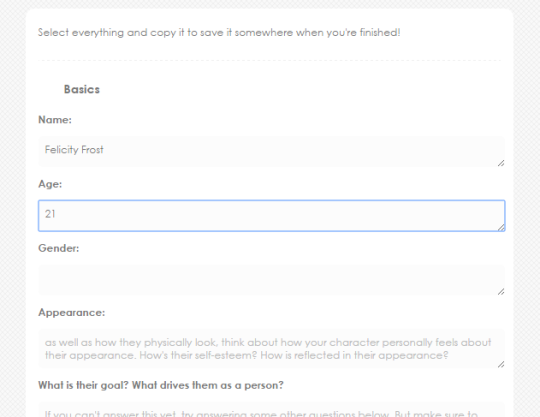
i dont think i ever made a post abt it here 😕 but i wrote a fillable character sheet a while back w the 25 questions that help me find the core of a character
if you go to jisho, it has an entire option to search names based on census data. this means that all the names and readings are actual real names that real people have, which is something that it’s easy to… not accomplish if you’re trying to name a character and aren’t familiar with the language’s naming conventions. with the fact that most names can be written more than one way (even within kanji usage that uses the actual readings of the kanji, and this increases exponentially when you consider the trend of “kira-kira names”, AKA names whose readings and kanji aren’t related) this also means that if you know a name you like the sound of, or you have a meaning you really want to work into your character’s name, you can find it by that as well. plus, a lot of the options are surnames, and some full names come up too, so you can make sure all around that your character has a legit name (and you’ll sound less like a weeaboo. no one wants to sound like a weeaboo.)
all you have to do to search names is put your search term (whether it’s a romaji reading or a kanji character) in the search bar and add #names after it. (you can also use this site to look up anything, since it’s also a general dictionary. this is really helpful if you do want your character to have a name that means something specific and you don’t know the word or kanji in japanese. add #kanji after the english word you’re searching for if you want to look for kanji specifically.)
plus, you can use this site in combination with lists of most common given names or surnames in order to find how you’d write those names in kanji (as many english sites listing surnames, in particular, don’t give the kanji at all. however, here’s a site that lists some common surnames with their kanji, and explains a bit about japanese surnames as a whole.) after all, they are the most common, so depending on the setting, a lot of the time it can be much more realistic to have a tanaka (田中) or a yamamoto (山本), for example, than a really unusual name.


 Tori's Blog of Mellarky